In 2026, bulk solids processors are under pressure to cut batch time, reduce cross-contamination risk, and keep maintenance downtime predictable—especially as SKU counts increase and quality audits tighten. The wrong horizontal mixer creates chronic issues: dead zones, segregation, slow discharge, excessive power draw, and long cleaning cycles. This guide compares a mixer ribbon (horizontal ribbon blender) vs. paddle mixers, and shows what to verify with horizontal ribbon blender suppliers before you purchase.
What Is a Mixer Ribbon and How Does It Work?
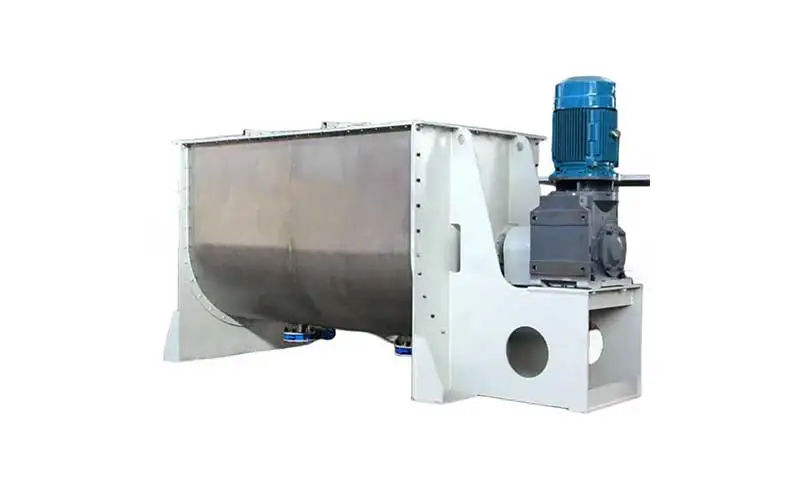
A mixer ribbon is a horizontal blender using inner and outer helical ribbons mounted on a central shaft inside a U-trough vessel. As the shaft rotates, the two ribbon sets move material in opposing axial directions simultaneously—the outer ribbon drives material toward the center while the inner ribbon drives it outward. This counterflow creates continuous radial turnover and achieves uniform blending across the full batch.
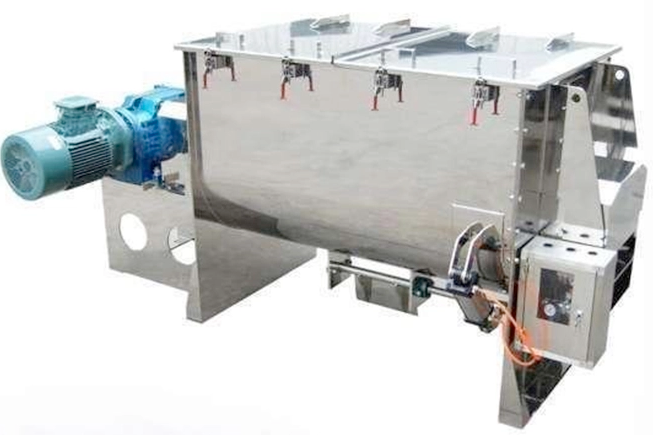
Ribbon blender mechanism summary:
Outer ribbon: moves bulk material axially toward the vessel center
Inner ribbon: returns material axially toward the vessel ends
Combined effect: three-dimensional counterflow that eliminates axial dead zones
Typical shaft speed: 30–60 RPM depending on material and vessel size
Paddle mixer mechanism—how it differs:
A paddle mixer replaces the helical ribbons with flat or angled paddle blades arranged along the shaft. Rather than driving axial counterflow, paddles lift and fold material with a scooping motion. The result is a gentler, less directional mixing action.
| Mechanism | Primary Motion | Shear Level | Best For |
|---|
| Ribbon agitator | Axial counterflow + radial turnover | Low–medium | Free-flowing dry powders, efficient turnover |
| Paddle agitator | Lifting and folding | Low–very low | Fragile granules, some cohesive materials |
Both can achieve good uniformity—but performance depends on material behavior, discharge design, and cleaning requirements. Choosing the wrong agitator type creates persistent quality and throughput problems that no operating adjustment can fully correct.
Key Configurations That Decide Performance
When evaluating horizontal ribbon blender suppliers, the specification sheet determines whether the equipment will perform on your actual material—or require constant workarounds.
Quote-critical specs to lock before purchasing:
Batch size and fill ratio: Ribbon blenders typically operate at 40–70% fill. Specify your minimum and maximum batch sizes—undersized batches in an oversized vessel reduce efficiency and can cause segregation.
Drive power and gearbox torque rating: Dense bulk solids create high starting torque. Confirm the gearbox service factor is rated for your material's bulk density, not just the vessel volume.
Vessel and ribbon material: Carbon steel, 304 SS, or 316L SS. Interior finish (standard mill finish vs. polished Ra ≤ 0.8 µm) affects cleanability and product residue risk.
Discharge valve type and placement: Full-bore flush bottom valves minimize residue and discharge time. Offset or end-mounted valves are a common source of dead zones and cleaning problems.
Sealing system: Gland packing vs. mechanical seals at shaft ends—mechanical seals perform better for fine powders and dust containment.
Options that affect results:
Liquid spray manifold: For minor liquid addition (coatings, binders, moisture correction)—nozzle placement and droplet size determine distribution quality
Choppers / intensifier bars: For de-lumping cohesive inputs or improving liquid dispersion
Jacket heating / cooling: For temperature-sensitive materials or processes requiring conditioned blending
Wear liners: Hardened steel or ceramic-faced liners for abrasive minerals, fertilizers, or ceramics—specify upfront rather than retrofitting after vessel wear
A note on supplier qualification:
Reputable horizontal ribbon blender suppliers will ask for your material data before recommending ribbon pitch, shaft speed, and power. If a supplier quotes without requesting bulk density, particle size, and flowability data, treat that as a red flag.
Where Ribbon Blenders Win—and Where Paddle Mixers Fit Better
Neither agitator type is universally superior. The right choice depends on your material's flow behavior, fragility, and your plant's cleaning and discharge constraints.
Ribbon blenders (mixer ribbon) are typically preferred when:
Materials are free-flowing to mildly cohesive powders or granules
Efficient axial turnover and short batch time are priorities
Batch sizes vary and fill ratio flexibility is needed
Power efficiency per unit of throughput matters
Dry blending of multi-component formulations with similar particle sizes
Paddle mixers are typically preferred when:
Materials are fragile granules or pellets that cannot tolerate ribbon shear
Very gentle lifting and folding action is required to preserve particle integrity
Certain sticky or cohesive blends respond better to the paddle's folding motion
The process involves wet or semi-wet materials where ribbon geometry creates buildup
Industry application examples:
| Industry | Typical Application | Preferred Agitator |
|---|
| Food powders | Seasoning blends, flour mixes, protein powder | Ribbon blender |
| Animal feed | Premix blending, complete feed formulation | Ribbon blender |
| Fertilizers | Granular NPK blending, micronutrient addition | Ribbon blender |
| Specialty chemicals | Additive dispersion, pigment blending | Ribbon blender |
| Pharmaceuticals | Fragile tablet granules, extended-release pellets | Paddle mixer |
| Ceramics / minerals | Abrasive powder blending (with liners) | Ribbon blender |
The mixer ribbon configuration covers the majority of bulk solids dry blending applications. Paddle mixers earn their place in specific fragile or semi-wet scenarios where ribbon shear creates unacceptable particle damage.
Supplier Selection Guide: Installation, Changeover, and Process Fit
Selecting the right equipment from the right horizontal ribbon blender suppliers requires a structured decision process—not a catalog comparison.
Selection workflow:
Step 1 — Define solids properties Collect bulk density (loose and tapped), particle size distribution, cohesion/flowability index (Carr Index or angle of repose), abrasiveness, moisture content, and temperature sensitivity. This data drives every subsequent specification decision.
Step 2 — Set throughput targets Define required batches per hour (or kg/hour), maximum allowable mixing time, and fill ratio range. Size the vessel so your standard batch fills 50–65% of vessel volume for optimal ribbon performance.
Step 3 — Confirm cleaning method and contamination risk Dry cleaning (vacuuming/brushing) or wet CIP/WIP? Any allergen or cross-contamination risk? This determines interior finish, seal type, and whether quick-release end covers are required.
Step 4 — Choose discharge design Full-bore flush bottom valve for complete emptying with minimal residue. Confirm valve actuation (manual, pneumatic, electric) and discharge height compatibility with downstream equipment.
Step 5 — Validate site constraints Floor space footprint, ceiling height for loading access, electrical supply (voltage/phase/Hz), dust collection connection point, and required automation level (manual, semi-auto, full PLC recipe control).
Practical procurement tip:
Ask your horizontal ribbon blender suppliers for a design-for-manufacturability (DFM) recommendation: ribbon pitch, shaft speed, motor power, gearbox torque rating, and discharge valve type—all matched specifically to your material profile and batch parameters. Suppliers who provide this without being asked typically have stronger application engineering experience.
Maintenance and Total Cost of Ownership
The purchase price of a mixer ribbon system is rarely the largest cost over a 10-year operating life. TCO is dominated by cleaning time, seal and bearing wear, discharge valve maintenance, and downtime from residue buildup.
Main TCO drivers:
Cleaning and changeover time: In multi-product operations, cleaning time per batch changeover often exceeds blending time. A full-bore flush discharge valve and polished interior can cut cleaning time by 30–50% versus a standard configuration.
Seal and bearing wear: Shaft end seals in direct contact with fine powders wear faster than seals protected by labyrinth or purge-air designs. Replacing seals reactively is always more expensive than scheduled preventive replacement.
Discharge valve maintenance: Slide gate valves accumulate powder in the gate channel; butterfly valves wear at the seat. Match valve type to material to minimize wear rate and replacement frequency.
Energy consumption: Per batch, a properly sized mixer ribbon with correct gearbox rating consumes less energy than an undersized motor running near full load or an oversized unit with poor torque efficiency.
Maintenance best practices:
Shaft seals: Inspect weekly for leakage or powder buildup at the seal housing; replace on a scheduled interval rather than at failure
Bearings: Follow manufacturer lubrication intervals; monitor temperature and vibration as early wear indicators
Ribbon and paddle fasteners: Check torque on tool mounting bolts quarterly—loose tools create uneven wear and mixing dead zones
Alignment: Annual shaft alignment check prevents premature bearing and seal failure
Discharge valve: Inspect seat and actuator linkage at every major cleaning; stock one spare valve assembly for zero-delay replacement
TCO tracking KPI:
Monitor total cycle time = mixing time + discharge time + cleaning/changeover time. In most operations, discharge and cleaning time account for 40–60% of the total cycle. Reducing these through better discharge design and surface finish delivers faster ROI than shortening mixing time alone.
Conclusion
For bulk solids, the best mixer is the one that matches your material's flow behavior and your plant's real operating constraints—discharge speed, cleaning frequency, and maintenance predictability. A mixer ribbon solution consistently excels for general dry blending and efficient counterflow turnover across a wide range of industries. Paddle mixers earn their place for fragile or semi-wet applications where ribbon shear creates unacceptable damage.
The fastest path to a confident decision is sharing your complete material data with qualified horizontal ribbon blender suppliers and requesting a configuration matched to your process—not a catalog default.
Ready to compare configurations and get a quotation?
Visit the mixer ribbon product page and submit the following to receive a recommended configuration and quotation from TVTION Machinery:
Operating conditions: material type, moisture level, abrasiveness, dust control needs
Quantity: required units and batches/day or kg/hour throughput
Size and specs: batch size, bulk density, particle size range, vessel material and finish requirements
Target metrics: mixing uniformity, max mixing time, residue tolerance, cleaning time target
Current problems: dead zones, segregation, slow discharge, hard cleaning, seal or bearing failures
FAQ
Q1: What is a mixer ribbon (ribbon blender)? A mixer ribbon is a horizontal blender using inner and outer helical ribbons to move bulk solids in opposing axial directions simultaneously, creating counterflow turnover for uniform blending across the full batch volume.
Q2: Ribbon blender vs. paddle mixer—what is the main difference? Ribbon blenders drive axial counterflow and efficient turnover for free-flowing powders; paddle mixers use a lifting and folding motion suited to fragile or some cohesive materials. Contact horizontal ribbon blender suppliers with your material data to confirm which agitator type fits your application.
Q3: How do I estimate ROI when choosing a ribbon blender? ROI typically comes from reduced batch time, fewer off-spec blends, faster discharge, and reduced cleaning downtime. Measure your current total cycle time (mix + discharge + clean) and compare against the target cycle with a correctly specified mixer ribbon configuration.
Q4: Do I need to modify my line to install a horizontal ribbon blender? Sometimes. You may need to adjust feeding method, dust collection connections, discharge height to downstream equipment, and electrical provisioning. Qualified horizontal ribbon blender suppliers will review your site layout as part of the specification process.
Q5: What do horizontal ribbon blender suppliers need to size and quote correctly? Provide material properties (bulk density, PSD, cohesion, abrasiveness), batch size and throughput target, required uniformity and mixing time, cleaning method, discharge preference, and site constraints. This data allows horizontal ribbon blender suppliers to recommend the correct ribbon pitch, shaft speed, power, and discharge configuration.
By Carson Zhao
The Founder of Tvtion Machinery Tech.
With more than 15 years of deep-rooted expertise in powder applications, I am Carson Zhao, the founder of Tvtion Machinery Tech, a company dedicated to delivering innovative and high-efficiency solutions for powder handling, mixing, screening, and processing across industries. My passion lies in solving complex powder-related challenges—whether in pharmaceuticals, food, chemicals, plastic, metal powder, etc. —by leveraging cutting-edge technology and hands-on industry experience.
Let's collaborate to transform your powder processes into a competitive advantage.
 EN
EN