If you have ever watched workers manually scooping flour into a mixer, hauling heavy bags of chemical additives across a production floor, or struggling to contain a cloud of fine dust around a packaging machine, you already understand the core problem that powder handling creates in industrial environments. Dust contamination, operator exposure, inconsistent material flow, and relentless housekeeping demands are not just operational inconveniences — they represent real costs in product quality, workplace safety, and production efficiency.
A powder vacuum transfer system solves these challenges by replacing open, manual material handling with an enclosed, automated, and precisely controlled method of moving dry powders from one point to another using negative air pressure. Whether you are running a food processing line, a pharmaceutical batch operation, or a chemical blending facility, understanding how vacuum pneumatic conveying works — and how to choose the right configuration — can transform the way your plant operates.
In this comprehensive guide, you will learn:
Exactly what a powder vacuum transfer system is and how it differs from other conveying methods
Step-by-step how vacuum pneumatic conveying works
The key components you need to understand before specifying any system
A clear comparison between vacuum and pressure pneumatic conveying
Industry applications, real-world benefits, common challenges, and practical troubleshooting
A buyer's checklist to help you choose the right powder transfer machine for your process
Let's start at the beginning.
What Is a Powder Vacuum Transfer System?
A powder vacuum transfer system is an enclosed mechanical system that uses negative air pressure — commonly referred to as vacuum — to pull dry bulk materials through a sealed pipeline from a pickup point to a destination. It is one of the two primary categories within pneumatic conveying: vacuum (negative pressure) systems and positive pressure systems.
In simple terms: a vacuum source creates a pressure differential between the pickup end and the receiving end of a conveying line. Because air naturally moves from high pressure to low pressure, it carries powder particles along with it through the enclosed pipeline. The powder arrives at the destination, gets separated from the air stream, and discharges cleanly into the next stage of the process.
As a broader category, the powder transfer machine includes both vacuum and pressure conveying technologies. However, vacuum transfer has become the preferred configuration for the majority of indoor industrial applications — particularly where dust control, contamination prevention, and operator safety are priorities.
In the field: In most plants, vacuum transfer is the first choice when powder must be fed into mixers, blenders, or packaging machines in a shared production space. Because the entire system operates at negative pressure, any small leak draws ambient air in rather than blowing powder out — which is a fundamental safety and cleanliness advantage that pressure systems cannot easily match.
How Vacuum Pneumatic Conveying Works (Step-by-Step)
Understanding the operating principle of a powder vacuum transfer system helps you make better decisions about configuration, sizing, and troubleshooting. The core physics are straightforward, but the practical details matter enormously in real installations.
The Basic Working Principle
A vacuum source — typically a vacuum pump, side-channel blower, or venturi ejector — is connected to a closed conveying system downstream of the receiving vessel. When activated, this vacuum source evacuates air from the closed system, creating a pressure that is lower than atmospheric pressure at the pickup point. The pressure differential drives airflow through the conveying pipeline, and that moving airstream entrains and carries powder particles from the pickup location to the receiver.
The driving force is simply the difference in pressure between the atmospheric conditions at the intake point and the vacuum conditions inside the receiving vessel. The greater the pressure differential, the higher the conveying velocity available — though more is not always better, as we will discuss when addressing powder degradation.
Typical Operating Cycle for a Batch Vacuum Receiver
Most powder vacuum transfer systems in food, pharmaceutical, and fine chemical applications operate on a repeating batch cycle. Each cycle consists of five stages:
Pickup — The vacuum source activates and air is drawn in at the pickup point, whether that is a suction wand inserted into a bag, a lance dropped into a bulk container, or a fixed connection to a bin or big bag station. Powder is entrained in the airstream and pulled into the conveying line.
Convey — The powder-air mixture travels through the pipeline toward the vacuum receiver vessel. Line length, diameter, bends, and airflow velocity all determine how efficiently this transfer occurs.
Separation — Inside the vacuum receiver, the conveying velocity drops sharply as the cross-sectional area increases. Larger particles fall out of suspension by gravity; finer particles are captured by the filter element before the air exits through the vacuum source.
Discharge — A discharge valve (flap valve, butterfly valve, or pneumatically actuated outlet) opens and the collected powder drops by gravity into the receiving vessel below — a hopper, mixer, blender, reactor, storage bin, or packaging machine feed throat.
Filter regeneration — Before the next pickup cycle begins, the filter is cleaned by a short pulse of reverse air (pulse-jet cleaning). This dislodges accumulated powder cake from the filter surface back into the receiver, ensuring consistent suction performance cycle after cycle.
Continuous vs. Batch Transfer: When Each Makes Sense
Batch vacuum receivers are the most common configuration for small-to-medium throughput applications: bag emptying into mixers, direct loading of packaging machine hoppers, or feeding reactors. They are simple, cost-effective, and easy to clean. The intermittent discharge cycle suits processes that accept short fill pauses between batches.
Continuous vacuum conveying becomes necessary when a downstream process requires an uninterrupted flow of material — for example, a continuously running extruder, a gravimetric feeder, or a blending line that cannot tolerate feed interruptions. Continuous configurations typically use dual-vessel systems (one filling while the other discharges), or combine vacuum transfer upstream of a surge hopper that buffers the flow. Rotary airlocks may also be incorporated to maintain vacuum integrity while allowing continuous powder discharge into pressurized or atmospheric receiving equipment.
Key Components of a Powder Vacuum Transfer System
Every powder vacuum transfer system is made up of several interdependent components. Choosing and sizing each one correctly for your specific powder and process is what determines whether the installed system performs reliably for years — or creates constant operational headaches.
Vacuum Source
The vacuum source provides the driving energy for the entire system. Three main technologies are used:
Side-channel blower (regenerative blower): The most common choice for general industrial applications. Delivers moderate vacuum levels (typically up to 200–300 mbar below atmospheric), handles continuous operation well, is relatively quiet, and requires minimal maintenance. Well-suited to most food, chemical, and plastics conveying applications.
Vacuum pump (rotary vane, claw, or screw type): Delivers deeper vacuum levels, enabling higher conveying velocities and longer conveying distances. The right choice for fine or dense powders, longer lines, or applications requiring greater pressure differential. Requires more careful maintenance but offers superior performance when conditions demand it.
Venturi ejector: Uses compressed air flow through a nozzle to generate vacuum — no moving parts, no electricity at the vacuum generator itself. Simple, compact, and easy to install. The trade-off is compressed air consumption, which can be significant at high duty cycles. Best suited for intermittent batch loading where compressed air is already available on the plant.
What matters in real installations: Match the vacuum source technology to your duty cycle, line length, and powder density. A venturi ejector running 20 cycles per hour will consume a surprising volume of compressed air; switching to an electric blower at higher duty cycles often reduces operating costs significantly.
Vacuum Receiver and Hopper Loader
The vacuum receiver is the vessel where powder is separated from the conveying air. It typically includes:
A receiving vessel (cylindrical body with conical base for reliable discharge)
A discharge valve (flap valve, butterfly valve, or dome valve depending on application and hygiene requirements)
Level sensors (capacitive, vibratory, or load-cell-based) for batch control and overfill protection
Connection points for the conveying inlet line, vacuum outlet, and filter housing
For simpler applications — loading a single machine hopper — compact hopper loaders (also called vacuum loaders) combine the receiver, filter, and discharge mechanism in a single compact unit that mounts directly onto the machine throat.
Filters and Dust Collection
The filter is arguably the most critical component in a powder vacuum transfer system and the one most often undersized or misspecified.
Cartridge filters using polyester, PTFE-coated, or nanofiber media are the standard for most industrial applications. The filter must be sized (in terms of filter area) relative to the powder's fineness, bulk density, and expected loading rate.
Pulse-jet cleaning uses short bursts of compressed air directed against the clean side of the filter to dislodge powder cake and regenerate filter efficiency between cycles.
HEPA-grade filtration is available for pharmaceutical and highly hazardous material applications where secondary containment of fine particles in the exhaust air is required.
Cyclone pre-separators can be added upstream of the main filter to remove the bulk of coarser particles before they reach the filter surface — significantly extending filter life when handling dusty, high-bulk-density materials.
What matters in real installations: Filter area must be matched to the air volume being handled and the powder's specific resistance to airflow. A filter sized for sugar will blind immediately when used with talc or fine pigment. Always specify the filter based on the finest, most challenging powder in your product range.
Conveying Line and Fittings
The conveying pipeline connects the pickup point to the vacuum receiver. Key design considerations include:
Hose vs. rigid pipe: Flexible hose is used for mobile systems, bag dump connections, and installations where pickup points change. Rigid aluminium, stainless steel, or food-grade plastic pipework is preferred for fixed installations — lower flow resistance, easier cleaning, more predictable performance.
Bend radius: Tight bends (short-radius elbows) are a leading cause of line plugging and pipe wear with abrasive materials. Use long-radius swept bends wherever possible, especially on horizontal-to-vertical transitions.
Sanitary fittings: Food, pharma, and nutraceutical applications require tri-clamp or equivalent fittings with smooth internal surfaces, no dead legs, and easy disassembly for cleaning and inspection.
Feeding and Pickup Devices
How powder enters the conveying line is as important as anything downstream:
Suction lances and wands: Handheld or fixed probes inserted into open bags, drums, or containers. Adjustable air bleed controls the powder-to-air ratio entering the line.
Bag dump stations: Enclosed hoppers with integrated dust containment, where operators empty bags through a filtered screen. Connects directly to the conveying inlet line, preventing dust escape into the production area.
Bin adaptors and big bag (FIBC) connections: Sealed connections to large containers for high-throughput batch feeding without operator contact with the material.
Controls and Automation
Modern powder vacuum transfer systems are typically controlled by a PLC-based control panel that manages:
Cycle timing (convey, filter clean, discharge)
Level sensor integration for demand-triggered operation (fill when low, stop when full)
Recipe storage for different materials (different conveying times, filter clean intervals)
Interlocks with downstream equipment (do not discharge into mixer while mixer is running, or vice versa)
Alarm and fault diagnostics for filter differential pressure, vacuum loss, and discharge valve position confirmation
Well-designed controls are not a luxury — they are the difference between a system that integrates smoothly into your production line and one that requires constant operator attention.
Vacuum vs. Pressure Pneumatic Conveying: What's the Difference?
Understanding where vacuum conveying fits relative to pressure (positive-pressure) pneumatic conveying helps you make the right technology choice at the outset and prevents expensive retrofits later.
| Feature | Vacuum Conveying | Pressure Conveying |
|---|
| Operating principle | "Pull" — negative pressure draws material | "Push" — positive pressure drives material |
| Conveying distance | Typically up to 50–100 m (application-dependent) | Can exceed 200–500 m in dilute or dense phase |
| Throughput capacity | Low to medium (generally suited to batch feeding) | Medium to very high (suited to bulk transfer) |
| Multiple pickup points | Excellent — easy to pull from several sources into one receiver | More complex — requires pressure diverter valves |
| Dust containment on leaks | Excellent — leaks draw air in, not powder out | Poor — leaks blow powder into the environment |
| Explosion risk on leaks | Lower (leaks are inward) | Higher (pressurised powder can escape) |
| Energy efficiency | Good for short-to-medium distances | Often more energy-efficient for long distances |
| System complexity | Generally simpler and more compact | Rotary airlocks, pressure vessels add complexity |
| Typical use cases | Bag loading, machine feeding, in-plant transfer | Silo filling, long-distance bulk transfer, high-throughput lines |
Bottom line: If your priority is clean, safe, in-plant powder transfer over distances up to approximately 50–80 metres, with multiple potential pickup points and strict contamination control requirements, vacuum conveying is the stronger choice for the vast majority of applications. For long-distance bulk transfer — filling remote silos, conveying high tonnages over hundreds of metres — pressure systems are typically more cost-effective.
Where Powder Vacuum Transfer Systems Are Used (Applications)
The powder vacuum transfer system is one of the most versatile pieces of process equipment in industrial manufacturing. It is found across nearly every sector that handles dry bulk materials.
Food Processing
Materials: Flour, sugar, salt, cocoa powder, starch, dried milk powder, ground spices, protein powders
Typical endpoints: Weighing and dosing systems, planetary mixers, ribbon blenders, packaging machines (auger fillers, VFFS), sifters
Key requirement: Hygienic (food-grade) design, easy disassembly and cleaning, stainless steel contact surfaces
Chemical and Specialty Chemical
Materials: Pigments, resins, polymer powders, carbon black, mineral fillers, additives
Typical endpoints: Reactors, blenders, bagging lines, compounders
Key requirement: Chemical resistance, containment for hazardous materials, antistatic and explosion-proof configuration where necessary
Plastics and Compounding
Materials: Plastic pellets, powders, regrind, masterbatch concentrates, talc filler
Typical endpoints: Injection moulding machines, extruders, mixers
Key requirement: High throughput loaders for machine-side feeding; anti-abrasion pipework for regrind and filled compounds
Pharmaceutical and Nutraceutical
Materials: Active pharmaceutical ingredients (APIs), excipients (lactose, cellulose, starch), vitamin powders, herbal extracts
Typical endpoints: Tablet presses, capsule fillers, granulators, blenders, dispensing suites
Key requirement: Highest level of containment (operator exposure limits for potent compounds), full cleanability, material traceability, validation documentation support
Battery and Advanced Materials
Materials: Cathode and anode powders, graphite, lithium compounds, specialty minerals (note: specific conveying designs depend on material properties and safety classification — always consult a qualified engineer for combustible or reactive materials)
Typical endpoints: Mixing vessels, electrode coating lines
Key requirement: Strict dust containment, inert atmosphere conveying for moisture-sensitive or reactive materials
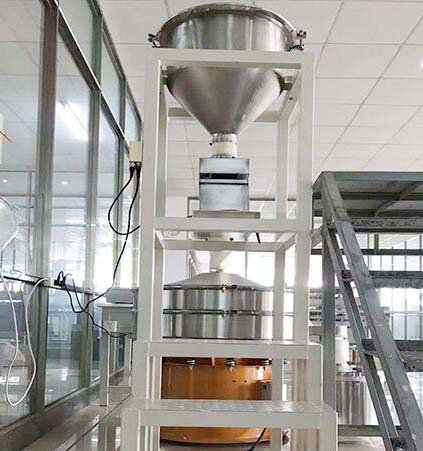
 Photo: Industrial powder vacuum transfer system installation showing key components. Alt text: Annotated powder vacuum transfer system components including vacuum receiver, filter housing, vacuum pump, and discharge valve for pneumatic conveying.
Benefits of Using a Powder Transfer Machine with Vacuum Conveying
The decision to invest in an enclosed powder vacuum transfer system rather than continuing with manual or semi-manual powder handling is driven by a combination of safety, quality, efficiency, and cost arguments. Here are the most significant benefits:
Dust Reduction and a Cleaner Workplace
Because the entire conveying path from pickup to discharge is enclosed and operating under negative pressure, powder never enters the ambient air of the production environment. This eliminates the visible dust clouds that characterise open bag tipping, manual scooping, and gravity-transfer through open chutes. The result is a measurably cleaner facility, reduced housekeeping burden, and significantly lower airborne particulate exposure for operators.
Reduced Contamination Risk (Closed Transfer)
In food and pharmaceutical manufacturing, even trace cross-contamination between product batches can trigger costly product failures, customer complaints, or regulatory findings. Fully enclosed vacuum conveying eliminates the open transfer steps where foreign matter — pests, lubricants, airborne particles from adjacent operations — can enter the product stream.
Lower Manual Handling and Improved Operator Safety
Repeatedly lifting, tipping, and emptying heavy bags or drums is a leading cause of musculoskeletal injury in manufacturing. Automating this task with a bag dump station connected to a vacuum transfer system reduces physical strain, frees operators for higher-value tasks, and reduces incident rates.
Consistent Feeding and Process Stability
Manual feeding introduces variability: different operators, different timing, different fill quantities. A demand-controlled vacuum transfer system feeds exactly the right amount of material at the right time, every cycle. Downstream processes — particularly batch mixing, gravimetric dosing, and timed packaging lines — benefit from the stability and repeatability this provides.
Flexible Pickup from Multiple Sources
A single vacuum receiver can be served from multiple pickup points — bag dump stations, bulk bags, storage hoppers, or drums — by switching suction lines. This flexibility suits operations with varying material sources or changeover requirements, without requiring separate dedicated conveying equipment for each source.
Easy Integration with Existing Equipment
Compact vacuum loaders and receivers are designed to mount directly onto the inlet throats of standard process equipment — mixers, extruders, tablet presses, packaging machines — without requiring significant structural modification. This makes vacuum conveying one of the most retrofit-friendly automation investments available.
Common Challenges (and How to Avoid Them)
No technology is without its operational challenges. The good news is that the most common problems with powder vacuum transfer systems are well understood and largely preventable through good system design and proper operation. Here is what to watch for:
Line Plugging and Material Bridging
Causes: Cohesive powders (high moisture content, fine particle size, or inherently sticky materials) tend to compact inside the conveying line, especially at bends, transitions, and low-velocity zones. Inadequate conveying velocity allows material to settle out of suspension in horizontal runs.
Fixes: Ensure conveying velocity is appropriate for the material's minimum pickup velocity. Use long-radius swept bends rather than short-radius elbows. Minimise horizontal runs and favour steeper incline angles. For highly cohesive powders, incorporate vibration pads at transfer points or consider a different conveying mode (plug/dense phase) where appropriate.
Filter Blinding and Loss of Suction
Causes: Very fine powders (sub-10 micron), high conveying concentrations, and inadequate filter area all contribute to rapid filter loading. If pulse-jet cleaning is not properly timed or the reverse-air pressure is insufficient, the filter cake builds progressively until suction collapses.
Fixes: Specify adequate filter area for your powder's PSD (particle size distribution) and bulk loading rate. Use PTFE-coated or nanofiber filter media for fine or sticky powders. Ensure pulse-jet compressed air supply is dry, clean, and at the correct pressure. Add a cyclone pre-separator upstream of the filter if handling high concentrations of coarser particles. Monitor filter differential pressure as a key performance indicator.
Powder Degradation and Segregation
Causes: Excessive conveying velocity mechanically fractures fragile particles (e.g., spray-dried agglomerates, crystalline materials, granules) through repeated impacts at bends and in the receiver. Very long conveying lines or multiple bends compound this effect.
Fixes: Use the lowest conveying velocity that reliably keeps the material in suspension. Minimise the number of bends in the conveying route. Design the receiver to provide a gentle, low-impact landing zone. If degradation remains a concern, consider dense-phase vacuum conveying (slower, plug-flow transport) rather than conventional dilute phase.
Static Buildup and Explosion Risk
Certain powder materials — particularly organic materials with fine particle sizes — are classified as combustible dusts and can pose explosion risks under specific conditions of concentration, confinement, and ignition. Static electricity generated by powder flowing through plastic hoses or ungrounded metal pipework can represent an ignition source.
Important: If your powder is or may be a combustible dust, do not attempt to manage this risk through general guidelines alone. A formal combustible dust hazard assessment (referencing applicable standards such as ATEX in Europe, or NFPA 652/654 in North America) must be conducted by a qualified engineer. Practical measures typically include:
Grounding and bonding of all metal system components
Conductive or dissipative hose and fittings
Explosion-proof motors and controls (ATEX-rated equipment where required)
Potential suppression or venting of receiver vessels depending on risk assessment outcome
How to Choose the Right Powder Vacuum Transfer System (Buyer's Checklist)
Selecting a powder vacuum transfer system requires a structured approach to your material properties, process requirements, and plant constraints. Use this checklist as a starting point for any system specification discussion.
Material Properties to Define First
Bulk density (loose and tapped, kg/m³) — determines volumetric flow rates and receiver sizing
Particle size distribution (PSD) — affects filter selection, minimum conveying velocity, and degradation sensitivity
Flowability (free-flowing, cohesive, very cohesive) — influences pickup device design and discharge valve selection
Abrasiveness — determines appropriate pipeline materials and wear-resistant fittings
Moisture sensitivity — may require dry conveying air or conditioned environment
Temperature — relevant for materials that soften, melt, or react at elevated temperatures
Tendency to bridge, cake, or compact — may require vibration aids, conditioners, or special discharge valve designs
Toxicity or containment classification — defines required operator exposure limits (OEL) and appropriate system containment level
Combustible dust classification — mandatory safety input; determines need for ATEX/explosion-proof design
Process Requirements
Required conveying distance (horizontal + vertical elevation change, in metres)
Number and location of pickup points
Number and location of discharge points
Required throughput (kg per hour or kg per batch)
Batch size and acceptable cycle time
Continuous feeding or batch feeding required?
Integration with downstream equipment (mixer, packaging machine, reactor, silo)
Required level of automation (manual start/stop vs. demand-triggered, recipe-based control)
Plant Constraints
Available utilities: compressed air supply (pressure and flow rate), electrical supply (voltage, phases)
Available footprint and headroom (ceiling height above receiving equipment)
Noise limitations (relevant for vacuum pump selection)
Cleaning method: dry, wet, or CIP (clean-in-place)
Maintenance access requirements
Hygiene and Compliance Requirements
Food-grade or pharmaceutical-grade material contact surfaces required?
Surface finish specifications (Ra value for pharma/food)
Material certificates for wetted parts (e.g., 316L stainless steel, FDA-compliant elastomers)
Full disassembly/cleanability required without tools?
Validation documentation required (IQ/OQ/PQ for pharmaceutical applications)?
Third-party inspection or certification requirements?
Need help sizing a system? Browse our full range of powder conveying system equipment or send your material data sheet and process requirements for a recommended configuration.
Maintenance and Best Practices for Long-Term Reliability
A well-designed powder vacuum transfer system requires minimal but consistent maintenance. The following practices protect your investment and prevent unplanned downtime:
Filter Maintenance
The conveying filter is the highest-wear consumable in most systems. Inspect the filter element at regular intervals (frequency depends on powder fineness and duty cycle — monthly inspection is a reasonable starting point). Replace filter elements before they blind completely rather than waiting for suction loss. Keep a spare filter element in stock.
Seal and Gasket Inspection
Gaskets on the receiver lid, discharge valve, filter housing, and pipeline clamp connections are exposed to repeated pressure cycling and powder contact. Inspect for cracks, compression set, or powder ingress at each planned maintenance interval. Replace worn seals promptly — a small vacuum leak upstream of the receiver will reduce conveying performance significantly.
Vacuum Source Service
Side-channel blowers are low-maintenance but benefit from periodic bearing inspection and impeller cleaning. Vacuum pumps (rotary vane, claw, or screw types) require oil changes or vane inspections according to the manufacturer's schedule. Venturi ejectors have no moving parts but check for erosion at the nozzle if handling abrasive powders.
Conveying Line and Hose Checks
Inspect flexible hose sections for kinking, cracking, or wear at connection points — particularly where hoses are repeatedly flexed during bag dump operations. Check rigid pipe clamp connections for security and gasket condition.
Operational Best Practices
Keep powders as dry as possible before loading — moisture causes cohesion and accelerates filter loading
Monitor vacuum gauge readings regularly; a trend toward lower vacuum at full pump operation is an early warning of filter blinding or a line leak
Log cycle times; a trend toward longer fill times for the same batch weight indicates reduced system performance
Clear the conveying line completely at end-of-shift before shutdown to prevent material compaction overnight
FAQs About Powder Vacuum Transfer Systems
1. What is the difference between a vacuum loader and a vacuum conveyor?
The terms are often used interchangeably in casual usage, but there is a practical distinction. A vacuum loader (or hopper loader) is typically a compact, self-contained unit designed to load material into a single machine — a mixer, extruder, or packaging machine — mounted directly on the machine's inlet. A vacuum conveyor or vacuum conveying system usually implies a more complete, engineered installation that may include longer conveying distances, multiple pickup or discharge points, larger receivers, and more sophisticated controls. Both operate on the same vacuum pneumatic conveying principle.
2. Can a powder vacuum transfer system handle very fine powders like flour or talc?
Yes — fine powders like flour (typically 50–200 micron), starch, and talc (which can be sub-10 micron) are routinely conveyed by vacuum systems. Fine powders require careful filter specification (higher filter area, finer media grade, effective pulse-jet cleaning) and attention to minimum conveying velocity. Talc and similarly fine, low-bulk-density powders may benefit from a cyclone pre-separator to reduce filter loading. Proper system sizing for the specific PSD of your material is essential.
3. How far can a powder vacuum transfer system convey?
Practical conveying distances for vacuum systems depend on the vacuum level achieved, pipeline diameter, powder properties, and required throughput. For dilute-phase vacuum conveying, distances of 20 to 80 metres (total equivalent length including bends) are common in well-designed installations. Some high-vacuum pump configurations can exceed 100 metres. For longer distances, or where high throughputs over long runs are required, pressure conveying becomes more technically and economically appropriate.
4. How do you prevent dust leakage from a vacuum transfer system?
Because the system operates at negative pressure (below atmospheric), any imperfection in the pipeline, vessel, or seal draws ambient air into the system rather than allowing powder to escape outward. This is the fundamental dust-containment advantage of vacuum conveying. To maintain this advantage: keep all clamp connections tight, replace worn gaskets promptly, inspect hose connections regularly, and ensure all access doors and inspection ports on the receiver vessel are properly sealed.
5. What is better: a venturi vacuum generator or an electric vacuum pump?
Neither is universally superior — the right choice depends on your application. A venturi ejector has no moving parts, is compact, requires no electrical connection at the vacuum source, and is low-cost to purchase. However, it consumes compressed air continuously during operation, making it expensive to run at high duty cycles. An electric vacuum pump or side-channel blower has higher capital cost but significantly lower operating cost at medium-to-high duty cycles. For continuous or near-continuous operation, electric drives are almost always more economical. For infrequent, low-duty-cycle batch loading where compressed air is already available, venturi systems offer simplicity and low investment.
6. How do I size a powder transfer machine correctly?
Accurate sizing requires several key inputs: required throughput (kg/hour or kg/batch and cycle time), conveying distance and routing (horizontal, vertical, number of bends), powder bulk density, particle size, and flowability. From these, an engineer calculates conveying velocity, air volume requirement, pipe diameter, vacuum level, and receiver/filter sizing. Attempting to size a system without accurate material data almost always results in either an undersized system that cannot meet the required throughput or an oversized one that causes powder degradation and wastes energy. Work with your equipment supplier's engineering team and provide a representative material sample and data sheet wherever possible.
 Photo: Bag dump station with integrated vacuum pickup for dust-free powder loading in a food processing application. Alt text: Bag dump station connected to powder vacuum transfer system for enclosed, dust-free powder feeding in food manufacturing.
Conclusion: Making the Right Choice for Your Powder Handling Needs
A powder vacuum transfer system is one of the most effective tools available to manufacturing operations that need to move dry bulk materials cleanly, safely, and reliably within a production environment. By replacing open, manual powder handling with enclosed pneumatic conveying, these systems address the most persistent pain points in powder-intensive production: airborne dust, cross-contamination, operator exposure, inconsistent feeding, and relentless housekeeping effort.
To summarise the key decisions:
Vacuum conveying is best when you need dust-free in-plant transfer, multiple pickup points, integration with sensitive process equipment, and strict contamination control — over distances up to 50–100 metres
The right configuration (batch vs. continuous, vacuum pump vs. blower vs. venturi, compact loader vs. engineered system) depends on your powder properties, throughput requirements, and process integration needs
Proper specification starts with accurate material data: bulk density, particle size, flowability, moisture sensitivity, and combustible dust classification
Long-term reliability comes from correct component sizing — particularly the filter — and consistent preventive maintenance
Whether you are specifying a new installation, evaluating an upgrade to your current powder handling, or troubleshooting performance issues with an existing system, the framework in this guide gives you a foundation for informed decision-making.
Ready to Explore Your Options?
Our engineering team works with customers across food, chemical, plastics, and pharmaceutical industries to size and configure powder conveying systems for specific materials and process requirements. To get started:
Explore our powder conveying system equipment →
Or send your material data sheet and process requirements directly to our applications team for a recommended system configuration. We typically request bulk density, particle size distribution, required throughput, and conveying distance to provide a meaningful preliminary recommendation.
About the Technical Reviewer
This article was reviewed by the TVTION Machinery process equipment applications team, with experience in pneumatic conveying system design across food processing, pharmaceutical, chemical, and plastics industries. Our team assists customers with material testing data interpretation, system sizing, and configuration selection for both standard and custom powder transfer applications. Contact us for sizing assistance or application-specific guidance.
By Carson Zhao
The Founder of Tvtion Machinery Tech.
With more than 15 years of deep-rooted expertise in powder applications, I am Carson Zhao, the founder of Tvtion Machinery Tech, a company dedicated to delivering innovative and high-efficiency solutions for powder handling, mixing, screening, and processing across industries. My passion lies in solving complex powder-related challenges—whether in pharmaceuticals, food, chemicals, plastic, metal powder, etc. —by leveraging cutting-edge technology and hands-on industry experience.
Let's collaborate to transform your powder processes into a competitive advantage.
 EN
EN