A vacuum conveyor is sized from the required mass rate and the resistance of the entire pickup, pipeline, receiver and filter system. Motor power or pipe diameter alone cannot establish capacity.
Powder density, particle size, cohesion, moisture, fragility and air permeability change pickup and transport behavior. Route length, vertical lift, bends and feed device then determine pressure loss and operating stability.
Define the Transfer Duty
Source and destination equipment, elevations and available headroom
Required kg/h plus batch size and transfer-time window
Horizontal/vertical pipe lengths, bend count and flexible hose
Powder PSD, bulk density, moisture, temperature and flow behavior
Maximum acceptable particle damage or segregation
Hygiene, containment and combustible-dust classification
A quotation for a vacuum powder conveying system should show the route and duty assumptions. If site routing changes, the calculation must be checked again.
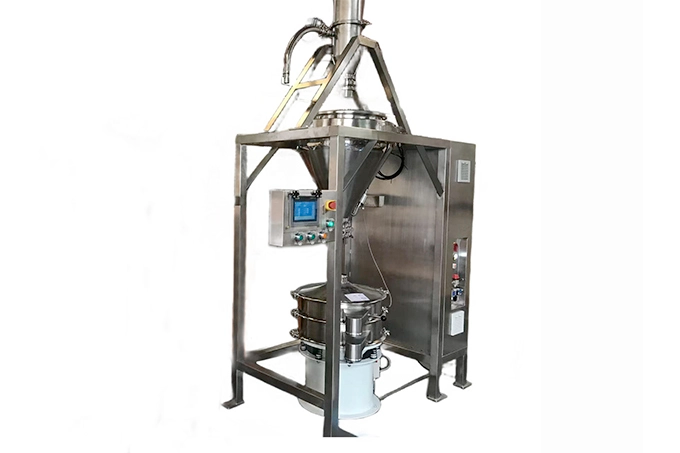
Select the Conveying Regime
Dilute-phase conveying uses higher gas velocity to keep particles suspended, while denser/plug-flow arrangements can reduce velocity and product damage but require material-specific control. The practical regime depends on the powder and equipment architecture.
Too little velocity causes saltation and blockage; excessive velocity increases attrition, pipe wear, dust, filter load and product heating. Establish an operating window through calculation and testing.
Calculate the Whole Pressure-Loss Path
| Element | Sizing effect |
|---|
| Pickup/feed valve | Air leakage and solids loading |
| Straight pipe | Friction and material acceleration |
| Vertical lift | Gravity and solids hold-up |
| Bends | Additional loss, wear and product impact |
| Receiver/filter | Separation, dust loading and cleaning loss |
| Vacuum source | Available flow across the required vacuum level |
The vacuum source curve must meet the system point after realistic filter loading, not only with a clean filter. Include leakage from valves and connections.
Design the Receiver and Filter Cycle
Receiver volume should support the transfer sequence without overfilling or starving downstream equipment. Define fill, settle, discharge and filter-cleaning timing. The discharge valve must handle the product and seal against vacuum reliably.
Filter area, medium, cleaning pulse and access depend on dust loading and hygiene. Sticky or ultrafine powders may need trials, alternative separation or a cleaning strategy beyond standard pulse-jet assumptions.
Safety and Validation
Combustible powders require a formal hazard assessment covering ignition control, earthing/bonding, equipment classification, explosion protection/isolation and safe venting as required. Vacuum does not eliminate dust-explosion risk.
For the acceptance trial, record material lot, route, mass transferred, time, residual heel, filter differential pressure, product damage and dust leakage. Test start/stop, low-level feed and a realistic filter condition.
Frequently Asked Questions
What pipe diameter should a powder conveyor use?
Diameter depends on air flow, solids rate, powder behavior and route. It must be calculated and validated as a system.
Can one vacuum conveyor handle several powders?
Possibly, but the operating window, cleaning and cross-contamination risk must be checked for each product.
Why does the line block at bends?
Low velocity, excessive solids loading, cohesive material, poor bend geometry or air leakage can cause deposition.
What capacity should be guaranteed?
Guarantee kg/h or batch transfer time for a defined material, route, condition and receiver/filter cycle.
Send a Route Drawing and Powder Sample
TVTION can size a conveying package after reviewing the route, source/destination, powder data and duty. Testing representative material is especially important for cohesive, fragile or ultrafine products.
By Carson Zhao
The Founder of Tvtion Machinery Tech.
With more than 15 years of deep-rooted expertise in powder applications, I am Carson Zhao, the founder of Tvtion Machinery Tech, a company dedicated to delivering innovative and high-efficiency solutions for powder handling, mixing, screening, and processing across industries. My passion lies in solving complex powder-related challenges—whether in pharmaceuticals, food, chemicals, plastic, metal powder, etc. —by leveraging cutting-edge technology and hands-on industry experience.
Let's collaborate to transform your powder processes into a competitive advantage.
 EN
EN