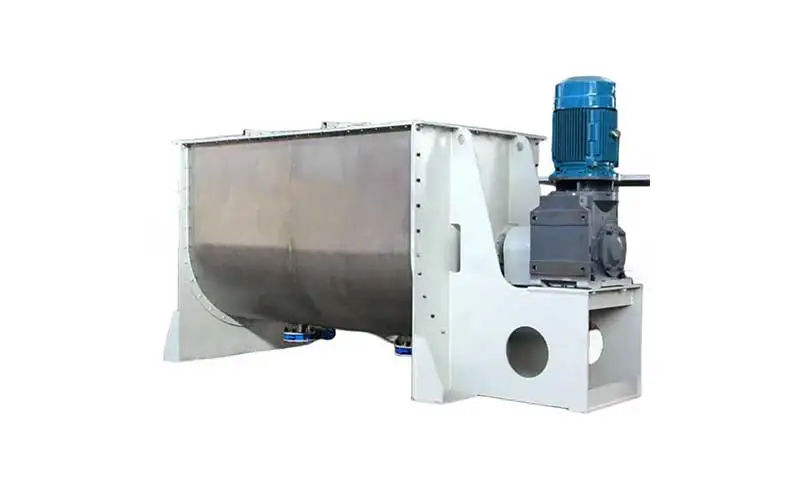
A ribbon blender moves powder axially and radially with inner and outer helical elements. Its performance depends on batch fill, ribbon clearances, speed, powder flow, ingredient ratio and discharge—not simply motor power or vessel liters.
The correct model should achieve a defined uniformity within a stable operating range while protecting particles and allowing the required cleaning method.
Define the Recipe Envelope
List the minimum and maximum batch mass, bulk density range, particle-size/density differences, cohesive behavior, fragile inclusions and liquid additions. A blender sized for the largest volume may perform poorly at the smallest batch if the ribbons are insufficiently covered.
TVTION’s horizontal ribbon blender should be quoted with both batch mass and working volume. State whether capacity refers to gross vessel volume or recommended operating fill.
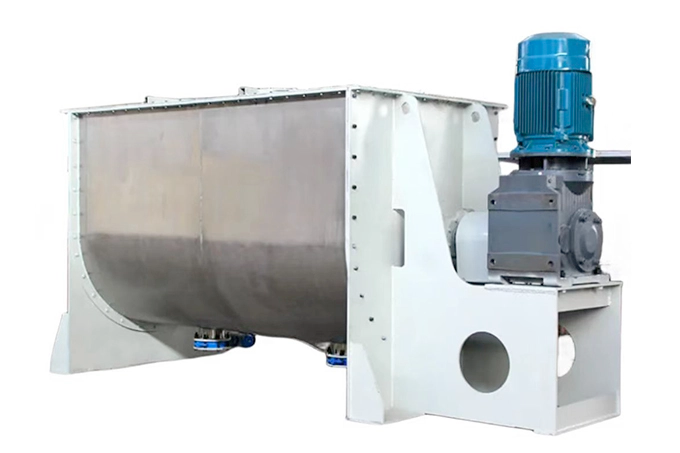
Ribbon Geometry and Clearances
Inner and outer ribbons are intended to create opposing bulk movement. Pitch, diameter, shaft, wall/bottom clearances and speed determine circulation and dead-zone risk. Abrasive products can increase clearances through wear; sticky powders can build up and change the effective geometry.
Do not reduce clearance without considering deflection, fabrication tolerance and thermal expansion. Metal contact can contaminate product and damage the machine.
Set Blend Time from Sampling
Choose a measurable tracer or key ingredient.
Use a defined ingredient addition sequence.
Sample at planned intervals with a validated technique.
Calculate uniformity against the product acceptance criterion.
Check for overmixing, attrition or de-mixing after the endpoint.
Confirm early/middle/late discharge fractions.
Blend time includes the endpoint under a specific fill and recipe. Charging, discharge and cleaning must be added when calculating batches per shift.
Discharge and Residual Heel
| Issue | Design check |
|---|
| Long discharge | Valve area, outlet location and downstream venting |
| Residual heel | Bottom contour, ribbon sweep and access |
| Segregation | Drop height, downstream hopper and packaging sequence |
| Leakage | Valve/seal compatibility with fines and cleaning |
| Cross-contamination | Drainability, removable parts and verification method |
Cleanability and Safety
Specify dry clean, washdown, CIP or product-dedicated use. Review weld finish, shaft seals, stuffing boxes, access doors, hollow sections, bearing separation and removable ribbon options. A polished surface does not eliminate inaccessible joints.
Interlock access doors and guard drives. Combustible-dust duties require project-specific earthing, ignition and explosion-risk controls. For food/pharma contact, require documentation for the exact material and finish.
Frequently Asked Questions
What is the working fill of a ribbon blender?
It is model- and recipe-specific. Enough powder must cover the active ribbons while leaving room for circulation.
Can a ribbon blender add liquid?
Yes in suitable designs with controlled spray, but agglomeration, distribution, seals and cleaning must be validated.
How long should powder be mixed?
Determine an endpoint from a blend-uniformity study for the actual recipe, fill, speed and sampling method.
Is a larger motor always better?
No. Torque and power must match startup and mixing load; excessive speed/power can damage product or equipment.
Calculate Line Capacity from the Full Cycle
TVTION can evaluate material tests and blender configuration. Include charging, blending, discharge, cleaning and changeover in the capacity target, then validate uniformity and yield with representative product.
```
By Carson Zhao
The Founder of Tvtion Machinery Tech.
With more than 15 years of deep-rooted expertise in powder applications, I am Carson Zhao, the founder of Tvtion Machinery Tech, a company dedicated to delivering innovative and high-efficiency solutions for powder handling, mixing, screening, and processing across industries. My passion lies in solving complex powder-related challenges—whether in pharmaceuticals, food, chemicals, plastic, metal powder, etc. —by leveraging cutting-edge technology and hands-on industry experience.
Let's collaborate to transform your powder processes into a competitive advantage.
 EN
EN