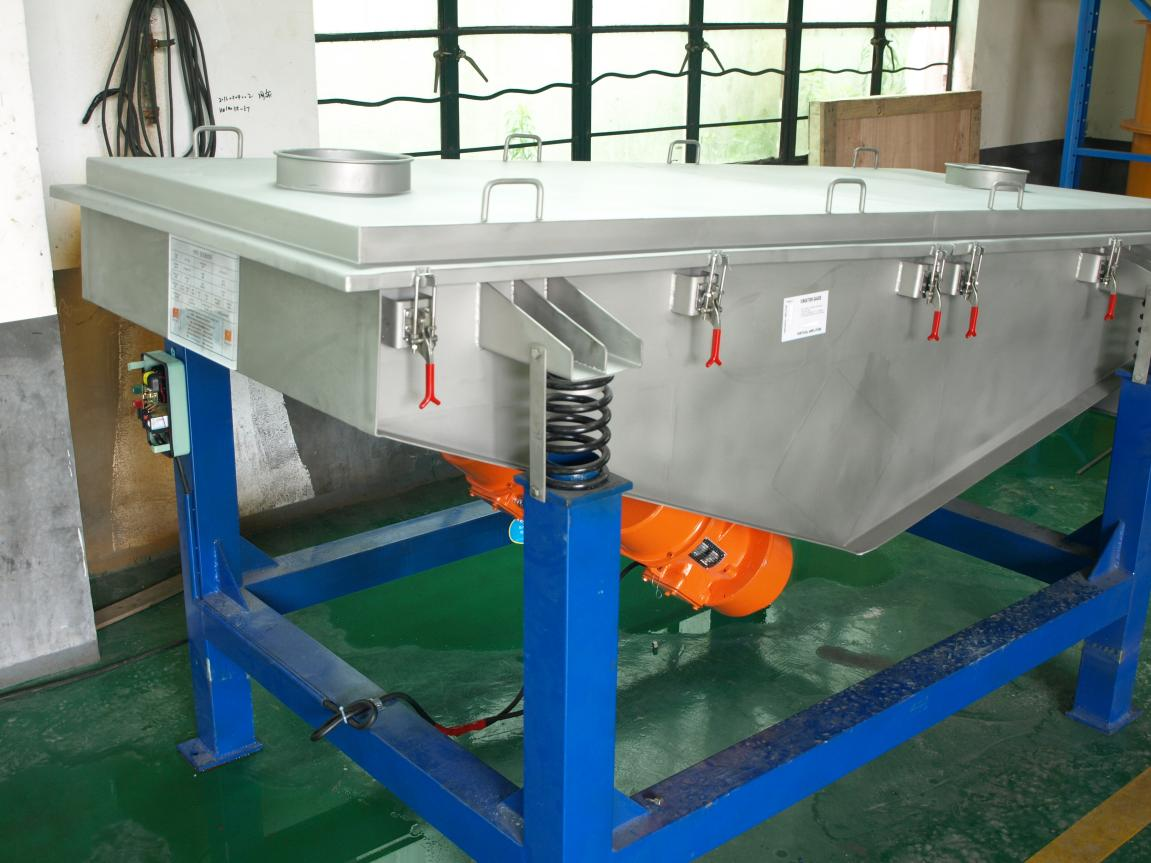
A linear sieving machine is designed for continuous screening, grading, and impurity removal of powders and granules. Compared with round sieving equipment, it usually provides a longer screening path and a directional material flow, making it suitable for production lines that need stable discharge, larger capacity, or multiple separations.
How a Linear Sieving Machine Works
A linear sieving machine uses vibration motors to generate linear motion. The material moves forward across the screen surface while particles smaller than the mesh pass through. Oversized particles continue to the discharge end. By adjusting vibration force, screen angle, and feeding rate, the machine can handle different materials and capacities.
The long screen deck gives material more time to contact the mesh, which can improve screening efficiency for certain powders or granules. Multi-layer designs can separate material into several grades in one process.
Linear vibration creates a directional material path.
Long screen decks support continuous production.
Multiple layers can produce several particle size grades.
Inlet and outlet direction can be designed for line integration.
When to Use Linear Screening
Linear screening is useful when the production line requires consistent material flow and clear separation. It is often applied in food processing, chemical powders, plastic pellets, minerals, fertilizers, and other industrial materials. For equipment matching, compare the specifications on the linear vibrating screen machine page before confirming specifications.
For materials with large capacity requirements or several grades, a linear vibrating screen can be more practical than a small round sieve. However, for compact safety screening or frequent product changes, a round machine may still be more convenient.
Use it for continuous screening with stable discharge.
Use it when the process needs a longer screening path.
Use it for granules, powders, or materials requiring multiple grades.
Consider another design if space is very limited or cleaning must be extremely frequent.
Linear Sieving vs Round Sieving
The main difference is material movement. A round sieving machine uses circular or three-dimensional vibration in a compact structure, while a linear sieving machine moves material forward along a rectangular deck. This affects capacity, footprint, discharge direction, and cleaning method.
A linear machine is often selected for higher throughput or production-line integration. A round machine is often selected for flexible safety screening and compact layout. For equipment matching, compare the specifications on the powder separator page before confirming specifications.
Linear sieving: directional flow, longer deck, good for continuous lines.
Round sieving: compact, flexible, and suitable for many general powder tasks.
The best choice depends on material, capacity, mesh, and layout.
Key Design Parameters
The performance of a linear sieving machine depends on screen area, mesh size, layer number, vibration force, feeding uniformity, and discharge design. Uneven feeding can overload part of the screen and reduce separation efficiency, so a feeding device may be needed for some materials.
For dusty or hazardous powders, sealing and dust collection are important. For food or pharma-related applications, stainless steel contact parts and easy cleaning should be considered.
Screen length and width.
Mesh size and number of screen layers.
Feeding method and material distribution.
Discharge outlet quantity and direction.
Dust cover, sealing, and cleaning access.
How to Request the Right Model
A good supplier will not recommend a linear vibrating screen based only on the material name. The supplier should ask for capacity, mesh size, particle distribution, moisture, bulk density, and process layout. If the material is difficult to screen, testing is strongly recommended.
Buyers should also ask about screen replacement, spare parts, vibration motor maintenance, and noise control. These details affect daily operation more than the initial purchase price.
Provide material characteristics and capacity per hour.
Confirm required separations and final product grades.
Share layout limitations, inlet height, and outlet direction.
Ask for a test video or sample screening if possible.
Frequently Asked Questions
What is a linear sieving machine?
It is a screening machine that uses linear vibration to move material forward across a screen deck, separating particles by size for continuous production.
What materials are suitable for a linear vibrating screen machine?
It can handle many powders and granules such as food ingredients, chemicals, plastic pellets, minerals, and fertilizers, depending on mesh size and material flow behavior.
Is linear sieving better than round sieving?
Linear sieving is often better for continuous flow and higher capacity. Round sieving is often better for compact, flexible safety screening. The right choice depends on the process.
Get a Project-Based Recommendation
Send your material data, mesh size, capacity, and layout requirements to receive a linear sieving machine recommendation.
By Carson Zhao
The Founder of Tvtion Machinery Tech.
With more than 15 years of deep-rooted expertise in powder applications, I am Carson Zhao, the founder of Tvtion Machinery Tech, a company dedicated to delivering innovative and high-efficiency solutions for powder handling, mixing, screening, and processing across industries. My passion lies in solving complex powder-related challenges—whether in pharmaceuticals, food, chemicals, plastic, metal powder, etc. —by leveraging cutting-edge technology and hands-on industry experience.
Let's collaborate to transform your powder processes into a competitive advantage.
 EN
EN