In 2026, powder processing operations across pharmaceutical manufacturing, food production, specialty chemicals, and battery material preparation are under a level of performance and compliance pressure that makes equipment customization a risk-control decision rather than an optional upgrade. Tighter batch uniformity specifications, stricter allergen and cross-contamination audit requirements, dust safety regulations for fine and explosive powders, and energy efficiency targets that are now tracked at the batch level — all of these pressures converge on the equipment selection decision in ways that make the standard-configuration ribbon blender an inadequate answer for most serious production environments.
A mixer ribbon system that is not matched to the specific bulk density, flowability, abrasiveness, and corrosion profile of the powder it will process will underperform from the first batch — producing inconsistent uniformity, excessive discharge residue, premature wear, or corrosion-driven contamination that generates audit findings and product quality failures. The ribbon blender specifications that determine whether the machine performs correctly are not visible in a product photograph or a basic capacity table: they are the motor power and gearbox torque margin matched to the powder density, the discharge valve design matched to the residue and cleaning requirements, and the material of construction matched to the corrosion and hygiene profile of the specific application. If you are currently evaluating a horizontal ribbon mixer for sale, this buyer's checklist provides the powder blender selection logic and custom industrial mixer configuration framework that procurement and engineering teams need to specify equipment that performs correctly from commissioning through the full service life.
How a Mixer Ribbon Works: The Mixing Mechanism and Why Powder Properties Decide Everything
Understanding the mixing mechanism of a ribbon blender — and the powder properties that determine how effectively that mechanism produces uniform blends — is the foundation for every configuration decision that follows.
The Ribbon Mixing Mechanism
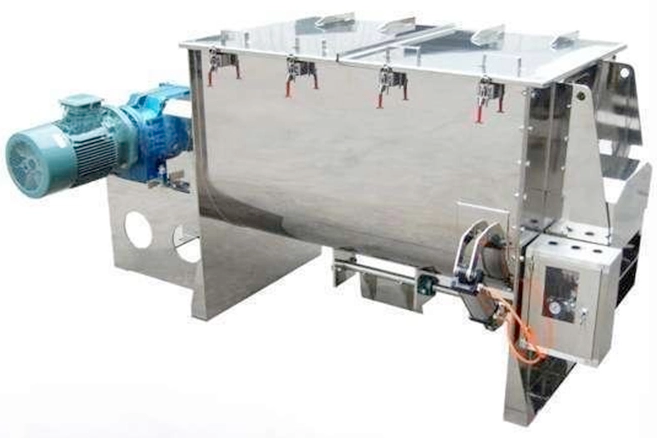
A horizontal ribbon blender operates by rotating a shaft-mounted mixer ribbon element inside a horizontal U-shaped trough. The ribbon element consists of two helical ribbons — an outer ribbon and an inner ribbon — wound in opposite directions around the same shaft. As the shaft rotates, the outer ribbon moves powder in one axial direction along the trough wall, and the inner ribbon moves powder in the opposite axial direction through the center of the trough. The opposing axial flows create a convective mixing pattern — bulk movement of powder from one end of the trough to the other and back — that is supplemented by radial mixing as powder cascades from the ribbon surfaces into the bulk.
This convective mixing mechanism is significantly faster than the diffusion mixing of tumble blenders for most powder types, because it actively moves large volumes of powder across the full length of the trough in each rotation cycle rather than relying on random particle redistribution by gravity. The mixing time required to achieve a target coefficient of variation is typically shorter in a ribbon blender than in a tumble blender for the same batch size and powder type.
The Powder Properties That Control Performance
The effectiveness of the mixer ribbon mechanism depends entirely on the physical properties of the powder being processed. These properties determine the motor power required to rotate the ribbon through the powder bed, the discharge valve design required to empty the trough completely, the material of construction required to resist corrosion and wear, and the seal design required to contain dust and prevent contamination.
Bulk density is the single most important powder property for drivetrain sizing. A high-density metal powder at 3000 kg/m³ bulk density produces three times the torque load of a low-density food powder at 1000 kg/m³ in the same working volume — a difference that requires a fundamentally different motor and gearbox specification. Specifying the same motor power for both applications is the most common and most costly configuration error in ribbon blender procurement.
Flowability and cohesiveness determine how readily the powder moves in response to the ribbon forces. A free-flowing powder follows the ribbon flow paths predictably and achieves uniform blending in a short mixing time. A cohesive powder that clumps or bridges resists the ribbon forces, produces dead zones where powder does not circulate, and may require a higher ribbon tip speed or a supplementary chopper element to break up agglomerates and achieve the target uniformity.
Particle size distribution determines the segregation risk — the tendency of particles of different sizes or densities to separate during mixing and discharge. A powder with a wide particle size distribution or a significant density difference between components is prone to segregation that can produce a blend that is uniform at the end of the mixing cycle but non-uniform in the discharged batch — a failure mode that is not detectable until the finished product fails the uniformity specification.
Abrasiveness determines the wear rate of the mixer ribbon surfaces, the trough lining, and the shaft seals. A highly abrasive powder — metal powders, mineral fillers, and ceramic materials — wears the ribbon surfaces and trough lining at a rate that depends on the hardness of the powder particles, the ribbon tip speed, and the material of construction. Uncontrolled wear produces metal contamination of the product and dimensional changes in the ribbon geometry that reduce mixing effectiveness over time.
In 2026, poor matching of the mixer ribbon configuration to the powder profile leads directly to rework, scrap, and audit findings from out-of-spec batches — making customization a risk-control investment, not a discretionary upgrade.
Ribbon Blender Specifications: Motor Power, Torque Margin, and Energy Cost Control
The motor power and gearbox specification is the most consequential engineering decision in the ribbon blender configuration — and the one that is most frequently under-specified by buyers who focus on working volume without considering the bulk density and torque load of the specific powder.
Motor Power Selection by Bulk Density and Load
The torque required to rotate the mixer ribbon shaft through the powder bed is proportional to the mass of powder in the trough, the friction coefficient between the powder and the ribbon surfaces, and the ribbon tip speed. For a given working volume and fill ratio, the torque load scales directly with the bulk density of the powder.
For high-density powders — metal powders, mineral fillers, and dense chemical intermediates — the motor power and gearbox torque rating must be sized with a margin above the calculated steady-state load to accommodate the startup torque and the transient torque spikes that occur when cohesive clumps break up or when the ribbon encounters a localized high-density region in the powder bed. A torque margin of 20 to 30% above the calculated steady-state load is a practical starting point, with a higher margin for cohesive or high-density powders where torque spikes are more frequent and more severe.
For low-density powders — food powders, pharmaceutical excipients, and light chemical powders — the motor power requirement is lower, but the configuration priorities shift to dust containment, gentle handling to preserve particle integrity, and surface finish for hygienic cleaning. A correctly sized motor for a low-density powder application operates at 80 to 90% of its rated load, which is the efficiency range where energy consumption per batch is minimized.
Undersizing the motor is the most common and most costly specification error. An undersized motor trips the overload protection during startup or during processing of a high-density batch, stopping the mixing cycle and requiring manual intervention to restart. Repeated overload trips accelerate motor and gearbox wear, reduce the service life of the drivetrain, and produce inconsistent batch uniformity because the mixing cycle is interrupted before the target uniformity is achieved.
Oversizing the motor wastes energy — a motor operating at 50% of its rated load operates at lower efficiency than a motor operating at 80 to 90% of its rated load — and increases the capital cost of the equipment without improving the mixing performance.
RFQ Specification Parameters for Comparable Quotations
To receive comparable and correctly sized quotations from multiple suppliers, the RFQ for a horizontal ribbon mixer for sale must specify the following parameters:
Working volume and total trough volume — the working volume is the volume of powder at the target fill ratio, typically 60 to 75% of the total trough volume. The total trough volume determines the physical size of the equipment.
Bulk density in kg/m³ and maximum batch weight in kg — these two parameters together determine the torque load on the ribbon shaft and the required motor power. A supplier who quotes without these parameters is guessing at the motor size.
Required mixing time and target uniformity expressed as coefficient of variation percentage — these parameters determine the required ribbon tip speed and the number of ribbon passes required to achieve the target uniformity, which affects the motor power and gearbox ratio specification.
Duty cycle — batches per day and continuous versus batch operation — determines the thermal load on the motor and gearbox and the required service factor for the drivetrain components.
Discharge and Dead-Zone Control: Choosing the Right Valve for Your Horizontal Ribbon Mixer for Sale
The discharge valve design is a quality, cleaning, and compliance decision that is as important as the motor power specification for operations with frequent product changeovers, allergen control requirements, or high-value powders where discharge residue represents a direct product loss and a cross-contamination risk.
Butterfly Valve
The butterfly valve is the most common discharge valve for ribbon blenders — cost-effective, mechanically simple, and suitable for most free-flowing powders. A butterfly valve opens by rotating a disc inside the discharge port, creating a full-bore opening that allows powder to flow by gravity into the downstream container or conveying system.
The limitation of the butterfly valve for high-changeover or allergen-controlled operations is the residual powder that remains in the valve body and around the disc when the valve is closed. This residual is a cross-contamination risk for the next product and a cleaning validation challenge for operations that must demonstrate complete removal of the previous product before the next batch. For operations with infrequent changeovers and non-allergen products, the butterfly valve is the cost-effective standard choice.
Ball Valve
A ball valve provides better sealing than a butterfly valve — the spherical closure element seats against a precision-machined seat, providing a more complete seal that reduces dust leakage and powder dribble between batches. Ball valves are preferred for applications where dust containment at the discharge point is a safety or compliance requirement, and for powders with fine particle sizes that leak through the clearances of a butterfly valve.
The limitation of the ball valve for high-changeover operations is the internal cavity of the ball — powder can accumulate in the cavity when the valve is in the open position and remain there when the valve is closed, creating a residual that is difficult to clean without disassembling the valve.
Full-Length Discharge and Flip-Plate Design
The full-length discharge — also called a full-open discharge or flip-plate discharge — opens the entire bottom of the trough along its full length, allowing the powder to discharge by gravity through the full trough cross-section rather than through a single port at one end. This design minimizes the discharge time, reduces the residual powder in the trough after discharge, and eliminates the dead zones at the ends of the trough that accumulate powder in single-port discharge designs.
For operations with frequent product changeovers, allergen control requirements, or high-value powders where discharge completeness is a product quality and economic requirement, the full-length discharge is the preferred design. The cleaning validation for a full-length discharge trough is simpler than for a single-port discharge with a butterfly or ball valve, because the full-length opening provides direct access to the entire trough interior for cleaning and inspection.
In 2026, cleaning validation and cross-contamination prevention are audit hot spots — the discharge design specification should explicitly state the maximum allowable residue in ppm and the cleaning access requirement, and the supplier should confirm that the proposed discharge design meets both criteria before the order is placed.
Discharge Valve Selection Summary
| Application Requirement | Recommended Discharge Design |
|---|
| General free-flowing powder, infrequent changeover | Butterfly valve — cost-effective and adequate |
| Fine powder with dust containment requirement | Ball valve — better sealing reduces dust leakage |
| Frequent changeover, allergen control, high-value powder | Full-length discharge — minimum residue and maximum cleaning access |
| Sticky or bridging powder | Full-length discharge — prevents dead zones at discharge port |
Corrosion, Hygiene, and Wear: SS316 Ribbon Mixer vs SS304 and Additional Upgrades
The material of construction selection for a custom industrial mixer is a long-term reliability and compliance decision — the wrong material choice produces corrosion-driven contamination, surface degradation that traps product residue, and premature equipment failure that generates unplanned downtime and replacement cost.
SS304 vs SS316 Ribbon Mixer: The Selection Logic
SS304 stainless steel — the standard austenitic stainless steel with 18% chromium and 8% nickel — provides adequate corrosion resistance for most dry powder applications where the powder is not corrosive, the cleaning agents are mild, and the operating environment does not involve chloride exposure. SS304 is the standard material of construction for general food, chemical, and pharmaceutical dry powder blending applications where these conditions are met, and it provides the cost-effective baseline for most ribbon blender configurations.
SS316 stainless steel — the molybdenum-bearing austenitic stainless steel with 16% chromium, 10% nickel, and 2% molybdenum — provides significantly better resistance to pitting corrosion in chloride-containing environments than SS304. The molybdenum addition stabilizes the passive oxide layer against chloride attack, which is the primary corrosion mechanism in applications involving chloride-containing powders, chloride-containing cleaning agents, or humid environments where chloride deposition on the stainless steel surface can initiate pitting.
Specify an SS316 ribbon mixer when the powder contains chloride salts or other corrosive components, when the cleaning protocol uses chloride-containing cleaning agents such as sodium hypochlorite, when the operating environment involves high humidity or condensation on the equipment surfaces, or when the hygiene requirements of the application demand the higher surface integrity and lower contamination risk that SS316 provides over the long service life of the equipment.
SS316L — the low-carbon variant of SS316 — is specified for applications where the equipment will be welded, because the low carbon content prevents sensitization at the heat-affected zone of welds that can reduce the corrosion resistance of standard SS316 in the weld area.
Additional Upgrades for Specific Powder Hazards
Shaft seal selection: a standard lip seal provides adequate sealing for most dry powder applications, but a purge seal — which uses a positive pressure of clean dry air or inert gas to prevent powder from reaching the seal face — is specified for applications where powder contamination of the seal area is a product quality or safety concern, particularly for toxic or highly potent powders.
Wear protection for abrasive powders: hard-facing the mixer ribbon edges with wear-resistant alloy, lining the trough with wear-resistant plate, or specifying a harder construction grade for the ribbon and trough extends the service life between ribbon replacement or refurbishment for highly abrasive powders. The wear protection specification should be based on the hardness and abrasivity of the specific powder and the target service life of the equipment.
Surface finish for hygienic applications: specify the required surface roughness in Ra micrometers and the polishing method — mechanical polishing or electropolishing — that achieves the required finish for pharmaceutical and food applications where hygienic design standards apply. A smoother surface finish reduces the surface area available for powder adhesion, which reduces the cleaning time and the risk of a cleaning validation failure.
Dust collection interface and inerting compatibility: for powders with explosion risk — Kst greater than zero — the ribbon blender must be equipped with a dust-tight enclosure, a dust collection connection at the feed and discharge points, and inerting compatibility if the powder's minimum ignition energy requires inert atmosphere processing.
Installation, Validation, Maintenance, and TCO: Making a Customized Mixer Ribbon System Pay Back
Text-Based Selection and Installation Workflow
Step one: define the complete powder profile. Document the bulk density in kg/m³, moisture content percentage, particle size distribution, cohesiveness and flowability classification, abrasiveness, toxicity and occupational exposure limit, dust explosivity classification, and any corrosive components. This profile is the engineering input that drives every configuration decision — a supplier who quotes without this information cannot provide a correctly sized or configured machine.
Step two: specify the complete configuration. Define the working volume and total trough volume, the motor power and gearbox torque margin based on the bulk density and batch weight, the mixer ribbon geometry and tip speed, the discharge valve type based on the changeover frequency and residue requirement, the material of construction based on the corrosion and hygiene profile, the shaft seal type based on the dust containment requirement, and the surface finish based on the hygienic design standard.
Step three: plan the plant integration. Define the feeding method — manual bag dump, bulk bag discharge, or vacuum conveying — and the discharge connection to the downstream packaging or conveying system. Confirm the available floor space and ceiling height for the equipment and the maintenance access requirements for ribbon inspection, seal replacement, and cleaning.
Step four: validate the performance. Define the mixing uniformity test method — the sampling plan, the analytical method, and the coefficient of variation acceptance criterion — and run the validation at the target fill ratio, mixing speed, and mixing time. Define the discharge completeness test and confirm that the residual meets the cross-contamination and product loss requirements of the application.
Step five: lock the documentation for audit readiness. Prepare the factory acceptance test and site acceptance test checklists, the spare parts list, the maintenance SOP, the cleaning SOP, and the batch record format before the equipment enters production service.
Maintenance and TCO Framework
| Cost Item | Standard Configuration (Mismatched to Powder) | Custom Mixer Ribbon System (Matched to Powder Profile) |
|---|
| Motor overload trips from undersizing | Higher — frequent trips for high-density powders | Lower — correct torque margin eliminates overload trips |
| Gearbox wear from torque spikes | Higher — undersized gearbox wears faster | Lower — correctly sized gearbox operates within rated load |
| Discharge residue and product loss | Higher — wrong valve design leaves residue | Lower — correct valve design minimizes residue |
| Cleaning time per changeover | Higher — dead zones and complex valve internals | Lower — full-length discharge and smooth surfaces reduce cleaning time |
| Corrosion-driven contamination | Higher — SS304 in chloride environment | Lower — SS316 ribbon mixer resists pitting in chloride environments |
| Ribbon and trough wear for abrasive powders | Higher — standard construction wears rapidly | Lower — hard-facing and wear liners extend service life |
| Audit findings from residue and contamination | Higher — inadequate discharge and surface finish | Lower — validated discharge completeness and hygienic surface finish |
Conclusion
In 2026, the mixer ribbon configuration decision is an engineering decision that must be made against the specific powder profile of the application — not as a standard configuration purchase. Motor power sized to bulk density and torque load, discharge valve selected for residue minimization and cleaning access, SS304 versus SS316 ribbon mixer selected for corrosion and hygiene profile, and wear protection specified for abrasive powders — these are the four configuration decisions that determine whether the equipment performs correctly from commissioning through the full service life.
The ribbon blender specifications framework in this guide provides the powder blender selection logic that procurement and engineering teams need to write a complete RFQ and evaluate supplier quotations on a comparable basis. If you are currently evaluating a horizontal ribbon mixer for sale, visit the TVTION horizontal ribbon blender product page to review the available configurations and submit your powder profile and performance targets for a matched custom industrial mixer recommendation and quotation.
Get Your Recommended Configuration and Quote
Visit the TVTION horizontal ribbon blender product page to review the available configurations, then submit the following details to receive a matched configuration recommendation and quotation:
| Parameter | What to Provide |
|---|
| Work condition | Industry (food, pharma, chemical, or metal powder), powder name, bulk density in kg/m³, moisture percentage, flowability and cohesion classification, abrasiveness, dust control requirements |
| Quantity | Kilograms per batch, batches per day, number of SKUs and changeovers per week |
| Size and spec | Required working volume, available footprint and height, preferred feed and discharge method, SS304 or SS316 requirement |
| Target metrics | Mixing uniformity as coefficient of variation percentage, maximum mixing time, discharge completeness percentage, allowed residue or carryover in ppm, energy target in kWh per batch |
| Current problem | Segregation, clumping, long discharge time, hard-to-clean dead zones, corrosion, dust leakage, inconsistent batches |
FAQ
1. What is a mixer ribbon?
A mixer ribbon is a helical mixing element consisting of inner and outer ribbons wound in opposite directions around a horizontal shaft inside a U-shaped trough. As the shaft rotates, the outer ribbon moves powder in one axial direction along the trough wall and the inner ribbon moves powder in the opposite axial direction through the center of the trough, creating a convective mixing pattern that achieves uniform blending faster than gravity diffusion tumble blenders for most powder types. The mixer ribbon geometry, tip speed, and trough clearance are the primary design parameters that determine the mixing effectiveness for a specific powder, and must be matched to the bulk density, flowability, and abrasiveness of the powder being processed.
2. Ribbon mixer vs paddle mixer vs tumble blender — which is better for my application?
A ribbon mixer provides fast convective mixing for a wide range of powder types and is the most versatile choice for batch blending applications where mixing time and uniformity are the primary performance requirements. A paddle mixer is gentler than a ribbon mixer and is preferred for fragile granules, cohesive pastes, and applications where the shear from ribbon tip speed would damage the product. A tumble blender — double cone or V-shell — is the gentlest option and is preferred for fragile coated granules and applications where GMP cleaning simplicity is the primary requirement, but is typically slower than a ribbon blender for equivalent batch sizes. The correct choice depends on the bulk density, flowability, fragility, and segregation risk of the specific powder, and the changeover frequency and cleaning requirements of the operation.
3. How does customizing a mixer ribbon system pay back in 2026?
The payback comes from four measurable sources. Correct motor sizing eliminates overload trips and gearbox wear that generate unplanned downtime and drivetrain replacement cost. Correct discharge valve selection minimizes discharge residue and cleaning time, reducing the labor cost per changeover and the risk of a cleaning validation failure that requires a production hold. Correct material of construction selection — SS316 ribbon mixer for corrosive applications — prevents corrosion-driven contamination that generates product quality failures and audit findings. Correct wear protection for abrasive powders extends the service life of the mixer ribbon and trough, reducing the frequency and cost of ribbon replacement or refurbishment. Together, these savings typically outweigh the upfront cost difference between a standard and a customized configuration within the first year of operation.
4. Do we need to modify our existing production line to install a horizontal ribbon mixer for sale?
Minor integration work is typically required but major building changes are not. The primary integration requirements are the feeding interface — manual bag dump station, bulk bag discharge frame, or vacuum conveying connection — the discharge connection to the downstream packaging or conveying system, the dust collection connection at the feed and discharge points, and the cleaning access planning for the trough interior, discharge valve, and shaft seals. The floor loading requirement for the filled trough must be confirmed against the structural capacity of the installation location, particularly for large-volume models processing high-density powders where the filled weight can be significant.
5. What parameters should I provide for correct mixer ribbon selection and quoting?</
By Carson Zhao
The Founder of Tvtion Machinery Tech.
With more than 15 years of deep-rooted expertise in powder applications, I am Carson Zhao, the founder of Tvtion Machinery Tech, a company dedicated to delivering innovative and high-efficiency solutions for powder handling, mixing, screening, and processing across industries. My passion lies in solving complex powder-related challenges—whether in pharmaceuticals, food, chemicals, plastic, metal powder, etc. —by leveraging cutting-edge technology and hands-on industry experience.
Let's collaborate to transform your powder processes into a competitive advantage.
 EN
EN